-
Email info@ijcmcs.org
-
Address 848 N. Rainbow Blvd. #5486 Las Vegas, NV 89107, USA
1Faculty of Social Sciences, Lagos State University, Nigeria.
2Faculty of Pharmacy, Olabisi Onabanjo University, Nigeria.
3Department of Medicine and Surgery, University of Ibadan, Nigeria.
4Department of Pharmaceutical Health Outcomes and Policy Research, University of Houston, USA.
5Department of Pharmaceutical Services, Borno State Hospitals Management Board, Nigeria.
6Georgia Southern University, Statesboro, USA.
*Corresponding author: Agbeni Kehinde Emmanuel
Department of Economics, Lagos State University, Nigeria.
Email: agbenikehinde333@gmail.com
Received: Dec 16, 2024
Accepted: Jan 07, 2025
Published Online: Jan 14, 2025
Journal: International Journal of Clinical & Medical Case Studies
Copyright: © Emmanuel AK (2025). This Article is distributed under the terms of Creative Commons Attribution 4.0 International License
Citation: Emmanuel AK, Abdul SO, Obasi DE, Jokoh PE, Malgwi JH, et al. Pharmaceutical market access and drug affordability in low-lncome nations. Int J Clin Med Case Stud. 2025; 2(1): 1003.
The pharmaceutical industry is going through a paradigm shift, and the dynamics of the sector are increasingly being shaped by emerging markets. The study aimed at examining the impact of regulation of distribution chains and tariff/tax exemptions on pharmaceutical market access and drug affordability in low-income countries. The study adopts cross sectional research design. Furthermore, the research method for this study is survey. The study population covered the total population of top management staff of pharmaceutical companies in Nigeria. The study adopted a total of 50 respondents drawn from the total population of the study using the convenient sampling technique. A structured questionnaire was used as instrument of data collection and the collected data were analysed with mean and standard deviation. The study concluded that regulations play a crucial role in streamlining distribution processes, leading to improvements in supply chain logistics and Tariff and tax exemptions play a crucial role in enhancing the availability and accessibility of essential medicines, particularly for vulnerable populations in low-income countries. The study recommended that lowering costs, these exemptions not only improve the diversity and availability of pharmaceuticals but also address significant gaps in supply. Additionally, tax and tariff incentives attract investment from international pharmaceutical companies and organizations, strengthening drug supply chains and fostering strategic partnerships.
Keywords: Pharmaceutical; Access to market; Drug affordability; Low-income countries.
The pharmaceutical industry is going through a paradigm shift, and the dynamics of the sector are increasingly being shaped by emerging markets. Pharmaceutical corporations used to concentrate their efforts on well-established markets, but as emerging economies gain clout, the tide is turning. Rapid economic growth, shifting demographics, and the rise of the middle class in Asia, Latin America, Africa, and the Middle East are all factors driving up demand for pharmaceuticals and healthcare services [1]. Since the pharmaceutical sector is always changing, industry participants must predict emerging trends [2]. Gaining entrance to the market involves a calculated combination of different strategies rather than a single effort. Managing growing markets comes with its own set of difficulties, from cultural considerations to legal restrictions. Developing successful market access strategy requires an understanding of these obstacles [3].
In many low-income nations, weak or inconsistent regulatory frameworks lead to delays in drug approvals, poor-quality medicines, and limited trust in local healthcare systems. Moreover, the absence of robust intellectual property frameworks often dissuades pharmaceutical companies from prioritizing these markets, further restricting access [4]. Another critical issue is the pricing strategies adopted by multinational pharmaceutical companies. Many low-income nations struggle with limited bargaining power when negotiating prices, resulting in medicines that are often unaffordable for the majority of the population. Efforts such as tiered pricing, wherein companies offer medicines at reduced costs for low-income countries, have had some success but remain inconsistent across regions and diseases [5].
Statement of problems
Drug affordability is a pressing concern in low-income nations, where a substantial portion of the population lives below the poverty line. Out-of-pocket expenditure accounts for a significant share of healthcare spending in these countries, placing an enormous financial burden on households. Studies indicate that in low-income nations, families often forego essential medicines due to cost, which exacerbates health inequities and leads to poorer health outcomes [6]. Access to essential medicines remains a critical challenge in low-income nations, where affordability and availability are significant barriers [7].
The pharmaceutical market in these regions is characterized by inefficiencies and inequities, often exacerbated by economic constraints, weak health systems, and fragmented supply chains [2]. Market access in the pharmaceutical sector refers to the ability of medicines to reach patients who need them. In low-income countries, achieving comprehensive market access is hindered by a combination of systemic issues. Firstly, inadequate healthcare infrastructure limits the distribution and delivery of medicines, particularly in rural and underserved areas [8]. According to the World Health Organization (WHO), approximately 50% of the population in low-income countries lacks reliable access to essential medicines due to logistical and infrastructural barriers.
Objectives of the study
i. To determine the impact of regulation of distribution chains on pharmaceutical market access and drug affordability in low-income countries.
ii. To establish the impact of tariff/tax exemptions on pharmaceutical market access and drug affordability in low-income countries.
Research question
i. What is the impact of regulation of distribution chains on pharmaceutical market access and drug affordability in low-income countries?
ii. What is the impact of tariff/tax exemptions on pharmaceutical market access and drug affordability in low-income countries?
Significance of the study
One of the key benefits of this study is its potential to improve health outcomes by identifying barriers to accessing affordable medications. By addressing these barriers, the study can help inform strategies that enhance the availability of life-saving medications, ultimately reducing disease prevalence and improving the quality of life for affected populations. The findings from this research will also provide valuable insights for policymakers, helping them design effective, evidence-based interventions so as to improved access to affordable medicines not only alleviates the burden of disease but also enhances productivity by enabling individuals to lead healthier lives.
Impact of regulation of mark-up distribution chains on pharmaceutical market access and drug affordability in low-income countries
A mark-up is defined as the additional charges and costs that are applied to the price of a product for the purpose of covering overhead costs, distribution charges, and profit [9,10]. Therefore, the implementation of pricing policies in the pharmaceutical distribution chain might include the regulation of wholesale and retail mark-ups and pharmaceutical remuneration [11,12]. The manufacturer’s selling price is the price of a product defined by its producer, and this is also the initial price of the whole supply chain [13]. Distribution costs and the wholesaler’s mark-up are the overhead costs applied on top of the manufacturer’s selling price. Following that, retailers add their own expenses to cover procurement and marketing costs.
The add-on price is then known as the retailer’s mark-up. The reason for putting mark-ups at various levels is to measure the supply and demand of a product in the market. When the price is higher, producers are motivated to produce more, hence boosting product sales. However, unchecked mark-ups could bring the flow of supply to a standstill if the majority of end-users cannot afford to buy the products [14]. If mark-ups are regulated, countries are highly recommended to use regressive mark-ups rather than fixed percentage mark-ups [15].
Regressive mark-ups mean lowering the mark-ups for higher-priced products. The fixed percentage mark-ups are less favourable, as they might contribute to a higher net margin for the higher-priced products and increase the price of low-cost drugs.
The procedures for calculating and regulating the size of mark-ups range from 0% mark-up allowed until more than 100% mark-ups. This proves that a single model does not suit all countries and must be modified according to the setting. With the implementation of regressive mark-ups policy, many countries found it beneficial to stop excessive charges being added to medicines as they pass along the supply chain. However, this policy requires a strong strategy of enforcement by the government as well as high-level political support to make sure it is efficient to control the drug price [16]. This narrative review provides insights into the framework of pharmaceutical mark-up systems by describing different factors impacting pharmaceutical prices and affordability. Price components, supply chain hierarchy, and regulatory measures affecting drug pricing will be discussed in this review [17].
Pharmaceutical price control measures are the mechanism used by low- and middle-income countries to keep drug prices in check while increasing affordability. In fact, analysis shows that even with the same policy, market differences between low-, middle-, and high-income countries can lead to significantly different results [18]. According to economic theory, if the marginal cost does not change, the market reaction to price cap adjustments is an increase in supply [19]. The cost of supply chains to rural areas is particularly high due to the lack of densely populated towns and cities, paved roads and other necessary infrastructure. However, increasing marginal costs can obscure the market’s reaction to price cap adjustments and reduce market supply [18].
The impact is especially severe if the law significantly reduces market-level supply, as in this case companies are most likely to withdraw their products from rural areas, and so health services become unavailable in these areas. Nevertheless, every policy has advantages and disadvantages once it has been implemented [20]. The regulation of mark-ups in the absence of any price control strategy causes medicine prices to drop. Plus, the implementation of this policy is less complicated as compared to the other available options because it only needs minimal information about the price of goods and the supply chain along with some enforcement capacity [16]. On the other hand, this policy may have a negative effect on availability and access through price fluctuation. Other than that, there would be a risk of higher prices if the development of the mark-up structure lacked transparency.
Impact of tariff/tax exemptions on pharmaceutical market access and drug affordability in low income countries
There are two major types of tax, direct tax and indirect tax. Direct taxes are levied by the government on the income of individuals and corporations, while indirect taxes are imposed on the price of goods and services. WHO/HAI surveys on medicines’ affordability and availability states that taxes are the third-largest part after the manufacturers’ price and distribution mark-ups. The mentioned additional costs would lead to a higher total cost paid by patients [21]. According to WHO, the selected low-income countries that applied high tariffs caused an increase of the price of medicinal ingredients by 23 percent and the price of the finished product by over 12%. WHO Guideline on Country Pharmaceutical Pricing Policies published in 2018 also identified the reduction or exemption of taxes on medicine, especially sales taxes is one of the main interventions that could increase medication affordability [16].
Similarly, the same WHO/HAI policy review also concerned the indirect taxes on medicines such as Value-Added Taxes (VAT) and sales taxes that are regressive as the percentage price paid by either rich or poor customers is the same [21]. The policy review concluded that VAT on medicines in high-income countries ranges from 0% to 25% while some countries such as Australia, Japan and the Republic of Korea exempted medicines from these taxes [22]. The benefit of tax exemptions or reductions for pharmaceutical products is providing an equity impact on the poor but the downside of it is that it causes a loss of revenue for national governments. It also might have a negative impact on some aspects of the health care system [21,23].
The study adopts cross sectional research design. Furthermore, the research method for this study is survey. The study population covered the total population of top management staff of pharmaceutical companies in Nigeria. The study adopted a total of 50 respondents drawn from the total population of the study using the convenient sampling technique. A structured questionnaire was used as instrument of data collection and the collected data were analysed with mean and standard deviation.
Demographic analysis of respondents
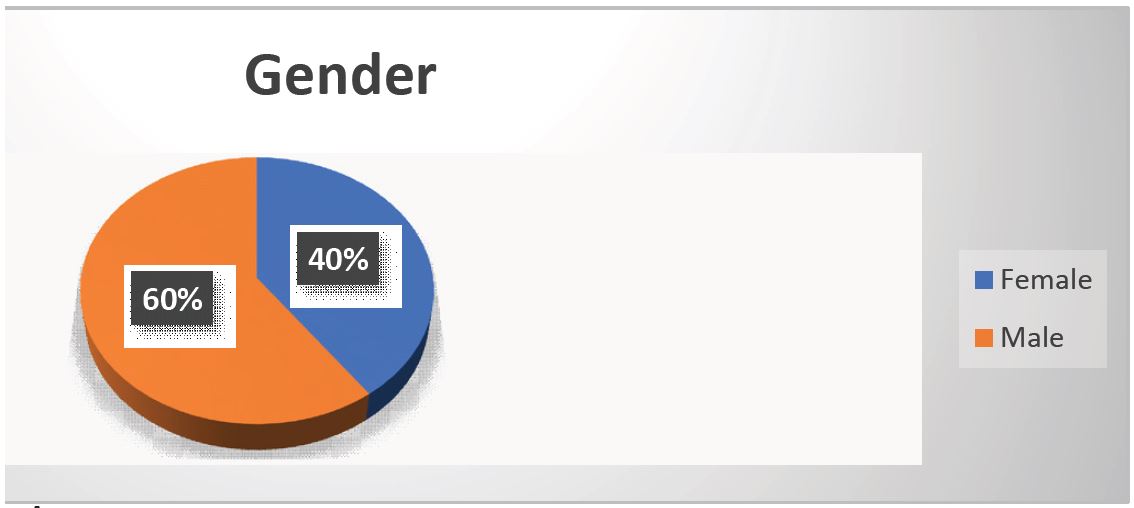
Distribution of respondents: Chart 1 showed that out of 50 respondents that attended the questionnaire, 60% were male while 20 40% of the respondents were female. This implies that there are more male respondents than female respondents.
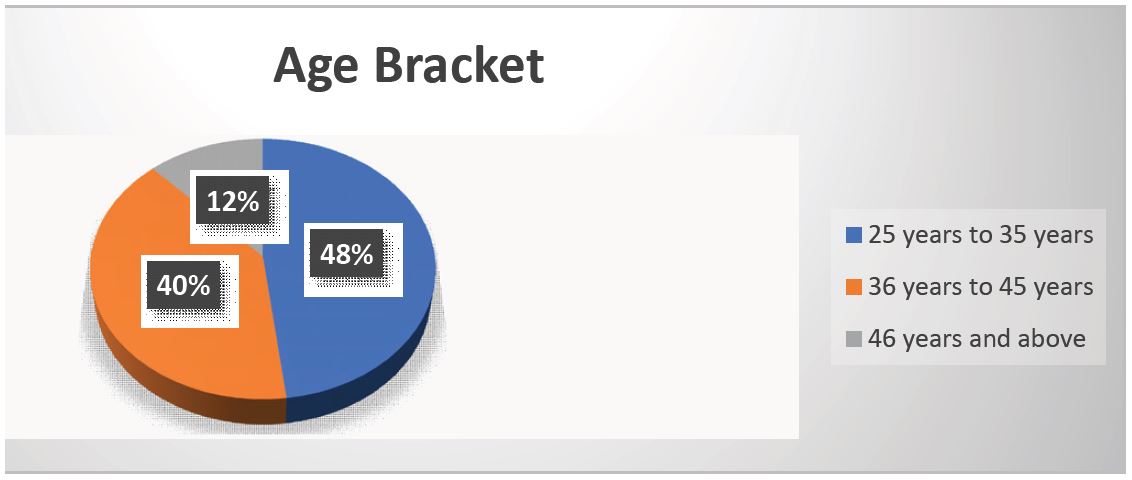
Age distribution of respondents: Chart 2 showed that out of 50 respondents that attended the questionnaire, 40 were between 35 years to 45 years, 48% of the respondents were between 25 years to 35 years and 12% were of 46 years and above. Therefore, there are more respondents of 36 years and above that those less than 36 years.
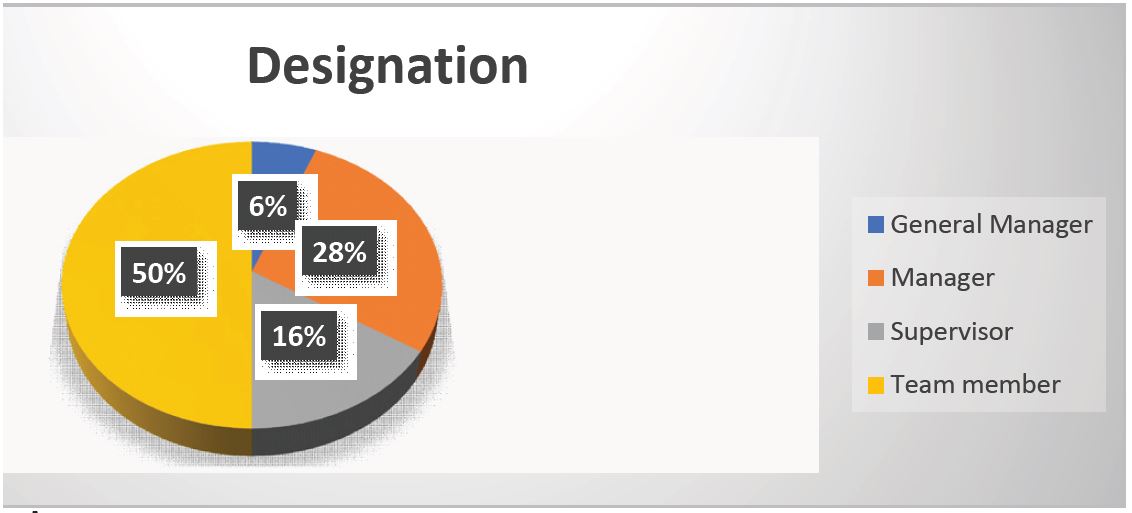
Designation distribution of respondents: Chart 3 showed that out of 50 respondents that attended the questionnaire, 50% were team members, 28% of the respondents were managers, 16% were supervisors and 6% were general manager. Therefore, there are more team members respondents than other category of designations.
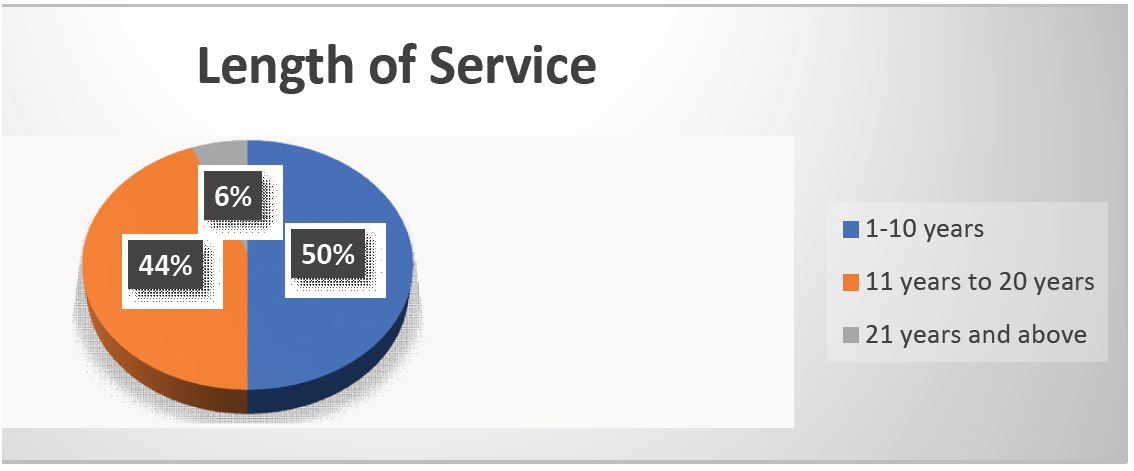
Length of service distribution of respondents: Chart 4 showed that out of 50 respondents that attended the questionnaire, 50% were had stayed in the organization for 1 year to 11 years, 44% of the respondents had stayed for 11 years to 20 years and 6% of the respondents had stayed for 21 years and above. Therefore, there are more respondents that had stayed in the organization from 1 year to 20 years.
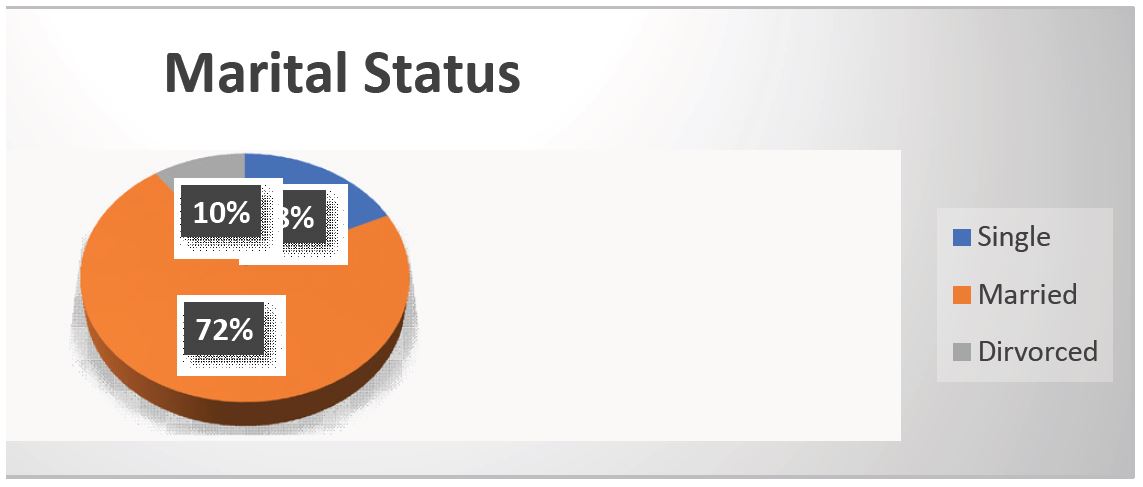
Marital distribution of respondents: Chart 5 showed that out of 50 respondents that attended the questionnaire, 72% of the respondents were married, 10% of the respondents were divorced and 8% of the respondents were single. Therefore, there are more married respondents.
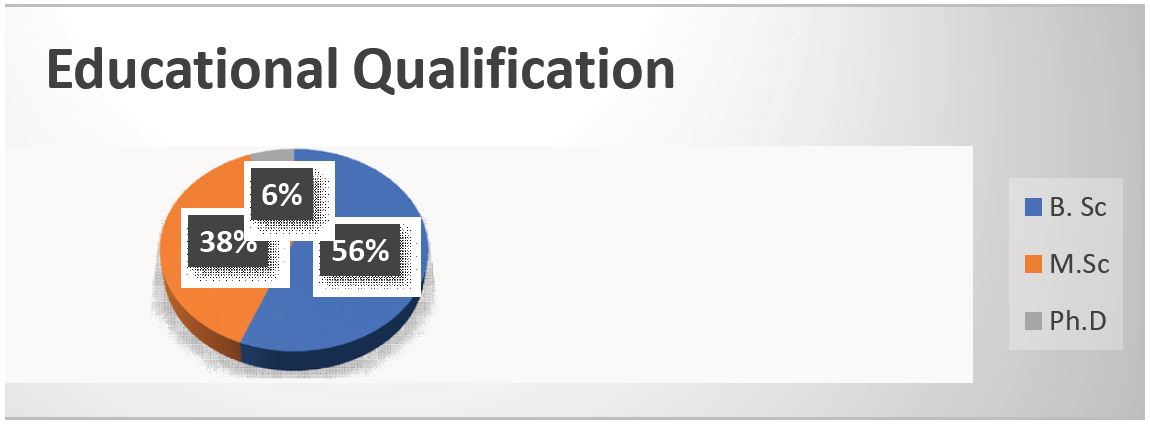
Educational qualification distribution of respondents: Chart 6 showed that out of 50 respondents that attended the questionnaire, 56% were obtained B.Sc, 38% of the respondents obtained M.Sc and 6% of the respondents obtained Ph.D. Therefore, there are more respondents B.Sc educational Qualification.
Data analysis base on research questions
| SN | Items | Number | Mean statistics | Stderror | Stddeviation |
|---|---|---|---|---|---|
| 1 | Regulations canstreamline distribution processes, to improve supplychain logistics. | 50 | 3.1800 | .11317 | .80026 |
| 2 | Regulation ensures that drugs distributed meet quality standards, | 50 | 3.2800 | .10706 | .75701 |
| 3 | By curbing inefficiencies andunethical practices regulation can lower the cost of medicines, making them more affordable forconsumers | 50 | 3.3800 | .11025 | .77959 |
| 4 | Regulations can prevent monopolistic behaviors, ensuring faircompetition among distributors. | 50 | 3.1600 | .11556 | .81716 |
| 5 | Clear regulatory frameworks canincentivize local pharmaceutical manufacturing by ensuring predictable distribution channels | 50 | 3.3600 | .11697 | .82709 |
| SN | Items | Number | Mean statistics | Std error | Std deviation |
|---|---|---|---|---|---|
| 1 | By lowering costs, tax exemptionsenhance the availability and accessibility of essential drugs, particularly for vulnerable populations. | 50 | 3.1800 | .11317 | .80026 |
| 2 | This can improve the diversity and availability of medicines in these markets, addressing gapsin supply. | 50 | 3.2800 | .10706 | .75701 |
| 3 | Tariff and tax incentives can attractinvestment from international pharmaceutical companies and organizations, improving drug supply chains and fosteringpartnerships in low-income countries. | 50 | 3.3800 | .11025 | .77959 |
| 4 | Tariff and tax exemptions directlylower the cost of imported pharmaceuticals by eliminating import duties, value-added taxes (VAT),and other levies. | 50 | 3.1600 | .11556 | .81716 |
| 5 | Insome cases, exemptions on raw materials and intermediate goodsfor pharmaceuticals support local manufacturing by loweringproduction costs. | 50 | 3.3600 | .11697 | .82709 |
The data in Table 1 showed the mean and standard deviation of respondents on the impact of regulation of distribution chains on pharmaceutical market access and drug affordability in low income countries. Given the 2.50 benchmark for acceptance, items 1-5 had mean above the benchmark indicating that there is the impact of regulation of distribution chains on pharmaceutical market access and drug affordability in low income countries. In summary, respondents agreed that regulations can streamline distribution processes, to improve supply chain logistics as the agreed that regulation ensures that drugs distributed meet quality standards, by curbing inefficiencies and unethical practices regulation can lower the cost of medicines, making them more affordable for consumers. Regulations can prevent monopolistic behaviours, ensuring fair competition among distributors and clear regulatory frameworks can incentivize local pharmaceutical manufacturing by ensuring predictable distribution channels
The data in Table 2 showed the mean and standard deviation of respondents on the impact of tariff/tax exemptions on pharmaceutical market access and drug affordability in low-income countries. Given the 2.50 benchmark for acceptance, items 6-10 had mean above the benchmark indicating that there is the impact of tariff/tax exemptions on pharmaceutical market access and drug affordability in low-income countries. In summary, respondents agreed that by lowering costs, tax exemptions enhance the availability and accessibility of essential drugs, particularly for vulnerable populations. This can improve the diversity and availability of medicines in these markets, addressing gaps in supply. Tariff and tax incentives can attract investment from international pharmaceutical companies and organizations, improving drug supply chains and fostering partnerships in low-income countries. Tariff and tax exemptions directly lower the cost of imported pharmaceuticals by eliminating import duties, Value-Added Taxes (VAT), and other levies. In some cases, exemptions on raw materials and intermediate goods for pharmaceuticals support local manufacturing by lowering production costs.
Result for research question one indicated that there is the impact of regulation of distribution chains on pharmaceutical market access and drug affordability in low income countries as majority of the respondents agreed that regulations can streamline distribution processes, to improve supply chain logistics as the agreed that regulation ensures that drugs distributed meet quality standards, by curbing inefficiencies and unethical practices regulation can lower the cost of medicines, making them more affordable for consumers. Regulations can prevent monopolistic behaviours, ensuring fair competition among distributors and clear regulatory frameworks can incentivize local pharmaceutical manufacturing by ensuring predictable distribution channels.
Result for research question two revealed that there is significant impact of tariff/tax exemptions on pharmaceutical market access and drug affordability in low-income countries. Majority of the respondents claimed by lowering costs, tax exemptions enhance the availability and accessibility of essential drugs, particularly for vulnerable populations. This can improve the diversity and availability of medicines in these markets, addressing gaps in supply. Tariff and tax incentives can attract investment from international pharmaceutical companies and organizations, improving drug supply chains and fostering partnerships in low-income countries. Tariff and tax exemptions directly lower the cost of imported pharmaceuticals by eliminating import duties, Value-Added Taxes (VAT), and other levies. In some cases, exemptions on raw materials and intermediate goods for pharmaceuticals support local manufacturing by lowering production costs.
Regulations play a crucial role in streamlining distribution processes, leading to improvements in supply chain logistics. They also emphasized that regulatory measures ensure the distribution of high-quality drugs by addressing inefficiencies and unethical practices within the supply chain. Furthermore, respondents highlighted that effective regulation can reduce medicine costs, making them more affordable for consumers. Curbing monopolistic behaviours, regulations foster fair competition among distributors, which contributes to better market dynamics. Additionally, clear and well-implemented regulatory frameworks were identified as instrumental in encouraging local pharmaceutical manufacturing by providing predictable and stable distribution channels. These combined effects demonstrate the critical role of regulation in enhancing both access to and affordability of medicines in low-income countries.
Tariff and tax exemptions play a crucial role in enhancing the availability and accessibility of essential medicines, particularly for vulnerable populations in low-income countries. By lowerlowering costs, these exemptions not only improve the diversity and availability of pharmaceuticals but also address significant gaps in supply. Additionally, tax and tariff incentives attract investment from international pharmaceutical companies and organizations, strengthening drug supply chains and fostering strategic partnerships. Furthermore, the removal of import duties, Value-Added Taxes (VAT), and other levies directly reduces the cost of imported pharmaceuticals, making them more affordable. In some cases, exemptions on raw materials and intermediate goods also support local pharmaceutical manufacturing by lowering production costs, thereby boosting domestic production.
Recommendations
Based on the findings, the following recommendations are proposed:
1. Governments and relevant stakeholders in low-income countries should develop and enforce robust regulatory frameworks to streamline distribution processes, reduce inefficiencies, and ensure the supply chain operates effectively.
2. Regulatory bodies should implement stringent quality control measures to ensure that all distributed medicines meet established standards. This will help curb unethical practices and improve consumer trust in the pharmaceutical supply chain.
3. Policymakers should establish predictable and transparent distribution regulations to incentivize local pharmaceutical manufacturing, fostering a more self-sustaining and competitive pharmaceutical market.
4. Governments in low-income countries should prioritize tax exemptions on essential medicines, including import duties and Value-Added Taxes (VAT), to reduce costs and improve accessibility, particularly for vulnerable populations.
5. Policymakers should create favourable tariff and tax policies to encourage international pharmaceutical companies and organizations to invest in drug supply chains, fostering partnerships that strengthen local healthcare systems.
6. Governments should provide tax and tariff exemptions on raw materials and intermediate goods used in pharmaceutical production to lower manufacturing costs, stimulate local production, and enhance the availability of affordable medicines.
Acknowledgement & ethical statement: We also affirm that this paper is original and is not currently under consideration by any other publication. This study does not contain any studies with animal subjects performed by any of the authors.
Conflicts of interest: Authors have declared that no competing interests exist.
Data availability statement: Data sharing is not applicable to this article as no new data were created or analysed in this study.
Disclaimer (Artificial intelligence): Author(s) hereby declare that NO generative AI technologies such as Large Language Models (ChatGPT, COPILOT, etc) and text-to-image generators have been used during writing or editing of manuscripts.
Authors’ contributions: This work was carried out in collaboration among all authors. All authors read and approved the final manuscript.